



 +2.8M
A golf cart looks like the easiest vehicle in the world to cool. Open sides, a flat roof, a big battery pack already on board. Buyers reasonably assume you bolt a rooftop air conditioner to the canopy, connect two wires, and drive away in comfort.
In practice, a golf cart is harder to cool than a truck cab — and the reason is almost never the cooling capacity. It is voltage architecture and roof structure. Both are solvable. Neither is obvious.

The CoolPro2800 is available as a DC12V or DC24V unit, and as an AC 100–240V unit. A golf cart runs on a 36V, 48V or 72V pack. None of those connect directly to a 24V unit. Put 48V across a 24V compressor and you will not get more cooling; you will get a warranty claim.
There are three legitimate answers, and they are not equally good.
A DC-DC converter (48V or 72V down to 24V) is the cleanest route. It keeps the whole system DC, avoids an inverter stage, and lets the unit use its native low-voltage protection. Size it for continuous current at the ambient temperature inside the cart's electronics bay — not for the peak number on the datasheet. A converter that is adequate in January will derate in a 45°C August.
An inverter plus the AC version works, but you pay for it twice: roughly 10–15 percent conversion loss, a standing idle draw, and one more component that can fail in a damp, vibrating vehicle.
A separate 24V pack isolates the air conditioner from traction duty entirely. It is the most robust option and the heaviest — you are now carrying and charging two battery systems.
Whichever route you choose, do the runtime maths before you buy. A 48V 100Ah pack is 4.8 kWh, of which you should plan to use about 80 percent. Divide that by the unit's continuous draw for a realistic figure. The published 10-hour endurance assumes the intelligent frequency control modulates down — not a cart idling in direct sun with the controller at full output.
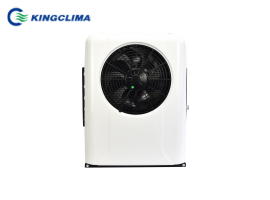
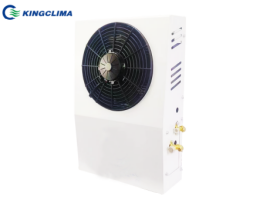
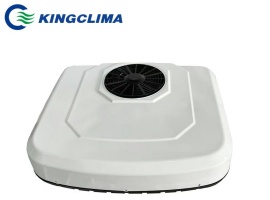
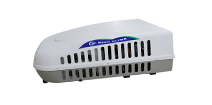
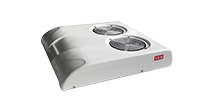
The CoolPro2800 weighs 27.69 kg and occupies a 900 × 804 mm footprint. Golf cart canopies are built to shed sun and rain. They are typically ABS, TPO or light aluminium on four struts, and they are not designed to carry a compressor, a condenser fan and the vibration that comes with both.
Mount it on a sub-frame tied into the chassis or roll cage, spread the load across the full footprint with a plate, and use vibration isolators. Bolting directly through the canopy panel will crack it within a season — usually at the mounting holes, usually on the first hot day.
Then consider what 28 kg does two meters up on a cart with a track width around 1.2 m. It raises the center of gravity on a vehicle that spends its life on side slopes and tight turns. Keep the mass low and central in the frame, and check stability with a loaded cart, not an empty one.
Also: wind uplift. A cart on a trailer at highway speed sees loads the canopy was never analyzed for.
Cooling a cart with open sides is not the same as cooling a sealed truck sleeper cab. You are not conditioning a volume; you are delivering spot cooling to a driver. Expect relief where the air lands, not a cabin temperature reading.
This matters commercially. If a buyer expects a sealed-car experience from an open cart, they will call it a failed installation. Set the expectation first: enclosed carts with doors or side curtains are where a rooftop air conditioner performs as designed — resort shuttles, security patrols, maintenance and grounds vehicles, marina and campus fleets, event operations.
Two maintenance realities that rarely appear in a brochure. First, a roof-mounted condenser on a golf course ingests grass clippings and pollen; a fouled coil loses capacity quietly. Blow it out weekly during the season. Second, if the air conditioner runs while the cart is on charge, it competes with the charger — schedule cooling for the shift, not the charge.
KingClima has built vehicle air conditioning and transport refrigeration since 2003, producing around 70,000 units a year. Our truck air conditioner programmes and our KingClima cold chain transport equipment are specified for continuous duty in heat, dust and vibration — the same design discipline behind this rooftop air conditioner. PWM control, a 19–22V low-voltage cut-off and 2.8 kW of cooling come from that background, not from a consumer appliance catalogue.
Four questions: what voltage is the pack, what is the continuous rating of the converter at 45°C, how is the roof tied to the chassis, and is the cart enclosed?
Send us those four answers and a photo of the canopy. We will tell you what the installation will actually deliver.
[!--lang.PREVIOUS--]: 12V or 24V Truck Air Conditioner: Matching Voltage, Battery and Runtime
[!--lang.NEXT--]: Rooftop Air Conditioning on a Yacht: An Engineer's Honest Guide

I am Mr. Wang, a technical engineer, to provide you with customized solutions.
Welcome to contact me

15 years Focusing on BusAir Conditioner, Truck Refrigeration Units, bus A/C parts.
 E-mail: info@kingclima.com
 Tel: +86-371-66379266
 Fax: +86-371-66379166
 No. 107, Pilot Free Trade Zone(Jinshui)Zhengzhou
City, China


Copyright © 2017-2020 Henan kingclima industry co,. ltd All Rights Reserved Sitemap Small Truck Refrigeration Units










(1).png)
.png)
.png)
.png)