



 +2.8M
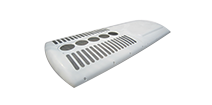
Every boat owner who looks at a rooftop air conditioner sees the same appeal. No seawater pump. No through-hull fittings. No refrigerant lines threaded through lockers. Bolt it to the coachroof, wire it to the house bank, and the cabin is cool by evening.
That is roughly right. But three marine-specific details decide whether the installation works — or becomes a leak, a corroded coil, or a dead battery bank by August.

We have built vehicle HVAC since 2003, and the fastest way to get a marine installation wrong is to treat a boat like a truck cab with a hull under it. The cooling duty is similar. Everything around it is not.
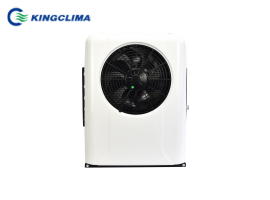
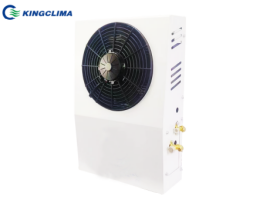
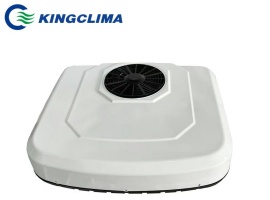
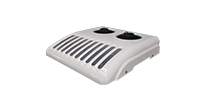
The condenser is the first component to fail in a saltwater environment. Salt film bridges the fin gaps, and once the coil is bridged, airflow drops and capacity falls with it. The CoolPro2800 uses a parallel-flow, double-fin condenser with a brushless fan and an anti-corrosion, anti-dust cabinet — a reasonable starting point. It is not a license to ignore maintenance. Rinse the coil with fresh water at the end of every saltwater season, inspect the fin edges annually, and replace any fastener that shows corrosion rather than tightening it.
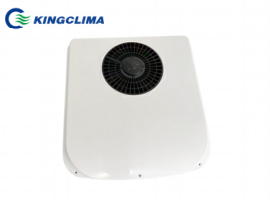
A rooftop air conditioner is designed to sit level. A sailboat at 15–20 degrees of heel is not level, and a flat drain pan will spill into the cabin instead of draining. Run the unit at anchor or in harbor, not while hard on the wind.
The drain itself matters more than most installers admit. Condensate must go to a sump or overboard through a skin fitting above the waterline, with a loop in the hose. Draining into the bilge is not a shortcut — it is a bilge pump working overtime and a damp boat.

The CoolPro2800 delivers 2.8 kW, roughly 9,550 BTU. That is sized around a truck sleeper cab — a volume in the same order as a berth or a compact cabin, around 6 to 10 cubic meters. It will not cool a full pilothouse with large glazing in the tropics, and we would rather say so than sell two units and an apology. One unit, one cabin, doors closed.
Most boats already run 12V or 24V DC, which is why this architecture transfers cleanly. The CoolPro2800 is available in both voltages.
Two rules from experience. First, wire it to the house bank, never the start bank. The 19–22V low-voltage cut-off protects whichever bank it is connected to, and the engine needs its own reserve. Second, size the cable from the nameplate rated current plus 25 percent headroom — not from the runtime figure. Inverters and thin cable are how 24V systems earn a bad reputation.
At anchor there is no alternator. The published 10-hour endurance assumes the intelligent frequency control can modulate down once the cabin is at temperature; in a 35°C ambient with a hot cabin, the compressor sits higher in its range. Plan the bank with margin.
The U.S. Coast Guard is direct about this: carbon monoxide can affect you whether you are underway, moored, or anchored. Running a generator to power air conditioning at anchor introduces a combustion source into exactly the situation where CO accumulates quietly.
A battery-driven rooftop air conditioner removes that source entirely. For a family boat, that is a stronger argument than any efficiency claim.
KingClima has manufactured vehicle air conditioning and transport refrigeration since 2003, with an annual output of around 70,000 units. The same engineering discipline behind our truck air conditioner platforms and our KingClima cold chain transport equipment — compressors, condensers, controls, and the failure modes that only show up after ten thousand hours — sits underneath this rooftop air conditioner. That is why we can tell you what the unit will not do, not only what it will.
Three checks: does the deck have solid backing under the 900 × 804 mm footprint, does the drain reach overboard above the waterline, and is the house bank sized for a full night rather than a demonstration?
If you are specifying a unit for a boat, a resort tender, or a specialized vehicle conversion, send us the cabin volume, the bank voltage and a photo of the mounting surface. We will tell you honestly whether one unit is enough.

I am Mr. Wang, a technical engineer, to provide you with customized solutions.
Welcome to contact me

15 years Focusing on BusAir Conditioner, Truck Refrigeration Units, bus A/C parts.
 E-mail: info@kingclima.com
 Tel: +86-371-66379266
 Fax: +86-371-66379166
 No. 107, Pilot Free Trade Zone(Jinshui)Zhengzhou
City, China


Copyright © 2017-2020 Henan kingclima industry co,. ltd All Rights Reserved Sitemap Small Truck Refrigeration Units










(1).png)
.png)
.png)
.png)